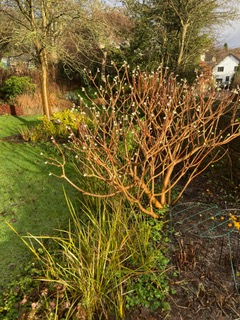
Plant of the month this February is Edgeworthia chrysantha ‘Grandiflora’ (paperbush). At the moment it’s not quite in bloom, but instead is covered in buds just waiting to open. Each bud is covered with tiny silver hairs, making the buds shimmer in the weak winter sun.
Once the leaves drop in winter, the young buds are revealed covering the bare reddish brown decorative bark. In Japan, the shrub’s bark has been used for making durable tissue paper called ‘mitsumata paper’ which is used for making bank notes, hence its common name of Paper Bush Plant.
In early spring it produces incredibly fragrant yellow and cream flowers before the leaves appear, providing a welcome source of food for any pollinators at this time of year. It is a relative of the Daphne, apparently sharing its preference for cool, lightly shaded spots. In my garden it receives sun until early afternoon when it is shaded by tall trees next door.
It grows to 1.5m by 1.5m in a pleasing goblet shape and although it is said to only tolerate temperatures down to -5C, I have grown it in my garden (admittedly located in the sheltered Kirkstall valley) for more than seven years with no problems.
I would highly recommend Edgeworthia as a fabulous plant for the winter garden.
What possible link could there be between celandines and swallows? The answer is stranger than you could possibly guess!
Chelidonium majus
It was whilst reading Fletcher’s Folly, one of H.L.V. Fletcher’s delightful ‘books of gardening gossip’ that I came across this very odd fact; for thousands of years people genuinely believed that swallows used the celandine to cure blindness in their chicks.
My first thought was that this couldn’t be so from a timing perspective, let alone anything else, because the celandine flowers in late winter and has pretty much disappeared by the time the first swallows are heralded in The Times (do they still do that?), let alone have any blind chicks in need of a cure. This however, was simply ignorance on my part – the celandine in question is the Greater Celandine (Chelidonium majus), which flowers in summer and is a member of the poppy family, not the Lesser Celandine (Ficaria verna subsp verna) which belongs to the Ranunculaceae.
In fact, the Greater Celandine gets its name from the Greek word for Swallow, Chelidon and one of its common names is the Swallow Wort.
The idea that Swallows would actually use this herb to cure their blind chicks, if indeed that is a problem for them, goes way back. This is what Dioscorides wrote in the first century AD:
It seems to be called Chelidonia because it springs out of the ground together with ye swallows appearing, & doth wither with them departing. Somme have related that if any of the swallowes’ young ones be blinde, the dames bringing this herbe, doe heale the blindness of it.
Even the great Aristotle seems to have believed that the Swallow could perform this amazing restoration, but by the time of John Gerard’s Herball (1597), disbelief is growing:
In fact, all swallows are born blind and develop their sight as chicks, which ismaybe where the idea that their sight needs to be restored originates. I doubt that their eyes, once plucked out, would regrow, though. If you are wondering at this point, why anyone would want to pluck out the eyes of a small bird, you may be horrified to learn that it was common practice until quite recently to prick out the eyes of caged songbirds, in the belief that it made them sing better. But swallows?
Aristotle, although regarded as the father of scientific study, did make mistakes. He said that men have more teeth than women and that flies have four legs. In both cases a bit of simple counting would have been a relatively simple task. So great was the esteem in which he was held that authors repeated that ‘fact’ that flies have four legs for a thousand years. It is therefore no great surprise that the belief that Swallows cured their blind chicks with Celandine survived so long, given how hard it would be to make sure.
Celandine, even though it is an irritant, was believed to be a herb of value for restoring clarity of sight. Some went even further with their claims for the plant, this is from the 16th Century Book of Secrets, supposedly written in the 13th Century by St Albertus Magnus:
If any man shall have this herb, with the heart of a Mole, he shall overcome all his enemies, and all matters In suit, and shall put away all debate. And if the before named herb be put upon the head of a sick man, if he should live, he shall sing anon with a loud voice, if not, he shall weep.
It has been suggested in the past that the whole association between Swallows and Celandines arose by chance, through a similarity of their names.
Perhaps that sits more comfortably with our modern view of the world, but if you should spot a Swallow wiping the eyes of her chicks, possibly through the lens of your webcam, I’d say a letter to The Times would probably be in order.
I imagine that all of us try to have something of interest in the garden throughout the year, but achieving this aim, particularly through the winter months, can be a real challenge. So much of this is weather dependent and, as each succeeding year seems to throw up new challenges, it is hard to know which plants can be relied upon to ‘do their stuff’ at any given time.
Nandina domestica ‘Firepower’
This, of course, is where foliage comes to the fore and evergreen shrubs, particularly I feel variegated ones, are a real boon. Variegated holly and elaeagnus not only brighten the garden but the foliage is very useful in floral arrangements. In recent years there have been a number of new varieties of Nandina domestica introduced that put on brilliantly coloured leaves; perhaps the most popular variety is the aptly named ‘Firepower’.
Latterly I have become more interested in, and appreciative of, ferns, particularly the evergreen forms. I have to admit that this is largely as a result of bringing some of the lovely examples from our friend David Barnes’ garden. I am totally useless when it comes to putting names to any of them, I just enjoy all the varying patterns on the fronds.
Ferns from David Barnes’ garden
Of all the plants in my garden at this time of year, the one that I would not want to be without is Viburnum x bodnantense ‘Dawn’ AGM. The Gardeners’ World website sums it up brilliantly: ‘Viburnum x bodnantense ‘Dawn’ is a fantastic winter-flowering shrub, bearing densely packed clusters of rose, pink or blush white, sweetly scented blooms’.
Viburnum x bodnantense ‘Dawn’‘Dawn’ from above – the shrub that is, not the time of day!
The flowers usually appear from September onwards while the leaves, which flush to mahogany, are still on the branches, and persist on the bare wood right through winter to spring. Even on a cold winter’s day you can detect the fragrance, and if brought into a warm house, they provide a lovely perfume.
Snowdrop shoots
Finally, while bracing ourselves for all that winter has in store, it is good to be able to look forward and one sign of hope are these shoots of Galanthus elwesii AGM – a gift from a generous HPS friend. Always the earliest to appear in my garden, who knows, the flowers might just make an appearance in time for Christmas.
Images courtesy of Sue Gray, except close-up of Viburnum bodnatense ‘Dawn’ – HPS Image Library
Here are three photos of Primula sikkimensis I took in Bhutan.
Primula sikkimensis in Bhutan
There must have been millions, a fantastic sight and possibly one of my favourite memories. A wonderful country with spectacular plants. Of the six Himalayan treks I went on, Bhutan was No. 1. I also went to Tibet, Yunnan, Sichuan, in China, Arunachal Pradesh and Sikkim in India
Firstly, a rider, all photographs, unless stated, are from my garden and are labelled with the name they were purchased as! There seems to be quite a lot of mis-sales, I have doubts about some, and I am a member of a Colchicum group where many people say the same. I presume some of this comes from the fact that we buy them as dry corms and not in flower.
In the latest Colchicum book by Christopher Grey-Wilson, Rod Leeds and Robert Rolfe published in October 2020, there are 104 species. They can be found in Europe, North Africa, West and Central Asia. They can also be called Naked Ladies because of flowering before the foliage appears.
They are usually goblet shaped in shades of white, pink and pale purple, (this is over simplifying them but I am not writing a book here). They grow from a large corm, and to tell the difference between Crocus and Colchicum, count the stamens! Crocus has 3 stamens, a style that divides into 3 and an ovary under the flower. Colchicum has 6 stamens, 3 styles and a superior ovary (the flower cups the ovary).
A medicinal use is the extraction of colchicine from Colchicum autumnale, which is used in the treatment of gout.
In cultivation there are varieties for the alpine house, the rock garden or scree bed, under deciduous shrubs or in turf, as seen here at Newby Hall in September.
Fig. 1
The Colchicums in my garden are fully hardy and grow in the open border or on the scree bed. I find them very easy, not fussy in any way. The rabbits seem to avoid them, maybe because of their poisonous nature. They can flower without being put in soil, flowering with no roots, seen as a novelty in some garden centres.
My Colchicum season starts in late August. Colchicum ‘Autumn Queen’, with chequered flowers and a white throat, being the first to flower (figs. 2 & 3)
Fig. 2
Fig. 3
At the beginning of September Colchicum agrippinum with heavily tessellated or chequered flowers, and smaller than ‘Autumn Queen’.
Fig. 4 Colchicum agrippinum
Flowering about the same time is Colchicum x tenorei, pink with a white midrib to the petal (fig. 5).
Fig. 5
In Fig 6 the front flowers are Colchicum byzantinum ‘Innocence’ with just a tip of purple to the white flowers.
Fig. 6
By mid September Colchicum autumnale ‘Nancy Lindsay’ flowers in a sunny border (fig. 7).
Fig. 7
The first white is Colchicum autumnale ‘Album’.
Fig. 8
By the end of September some have now finished flowering, but it is the main season for most, C. cilicium purpureum, (fig 9), the double ’Waterlily’, (fig. 10), C. speciosum ‘Album’, (fig. 11) and ‘Ocktoberfest’, fig. 12).
Fig. 9
Fig. 10
Fig. 11
Fig. 12
Two more that have definite names, flowering as I write on October 16th are C. speciosum ‘Atrorubens’, (fig. 13) and new to me this year, ‘Benton End’, (fig 14).
Fig. 13
Fig. 14
Before I finish, there are 2 anomalies, one that was sold as C. speciosum ‘Album’, which it obviously is not,(fig. 15) and one bulb that is doing 2 different things, (fig. 16).
Fig. 15
Fig. 16
They can be used in planting schemes – here are two pictures to give a couple of ideas of plant associations
Fig. 17
Fig. 18
But do remember the foliage, that feeds the corm for another year follows all these lovely flowers, here are 2 pictures taken on June 16th of Colchicum foliage.
Fig. 19
Fig. 20
Is this becoming like a Galanthophile obsession? As I gather more in the garden you have to look for the small differences!
As I pass this on to Brian for the website, they are still going strong at the end of October. I can cover 3 months in my garden but there are others out there to extend my season. This is ‘Dick Trotter’ today.
I suppose strictly speaking the dahlia does not fall into the category of a hardy plant but for the purpose of this article I am claiming “horticultural licence”
The garden dahlia, Dahlia x variabilis, is a cultivated plant derived from wild relatives found growing in Mexico. As far back as 1651 reports were published in Rome, originally in Latin, from a Spaniard who had spent several years in Mexico.
The first seeds to arrive in Spain were sent by the Director of the Mexican Botanical Gardens to the Madrid Botanic Gardens, these being grown and named as D.pinnata, D.coccinea and D.rosea (possibly Merckii).
Dahlia merckii
Dahlia coccinea
For many years it was believed that the dahlia had been introduced into Britain in 1789. The story of how this came about is complicated, involving Lady Bute, wife of the then Ambassador from England to the Court of Spain. (See ‘The Gardener’s Guide to Growing Dahlias’ by Gareth Rowlands – well worth reading and available from the RHS library at Harlow Carr.)
The advent of the double dahlia is thought to have occurred when the explorer Alexander von Humboldt sent seeds from Mexico to Paris and Berlin in 1804. It is thought that these seeds were not collected in the wild but came from garden plants grown by the Aztecs, who were great gardeners.
The development of decorative dahlias
During the early part of the nineteenth century regular consignments of tubers arrived in England from France and English nurserymen had started to develop new types. By 1836 the Royal Horticultural Society published the Dahlia Register, listing more than 700 varieties. The dahlia had become a popular flower with the wealthy and tubers of new varieties were known to change hands at a guinea a time, a lot of money in those days. A total of 45 Dahlia Shows were held in England in 1835 (a far cry from today’s shows, although it was good to see the flowers exhibited at the “Autumn Chelsea”).
Dahlia Classifications at Newby Show, 2021
Propagation and Cultivation (The words ‘Grandmother’ and ‘Eggs’ spring to mind)
Dahlias are grown from seed (as originally) and from tubers. Young seedlings develop a mass of fibrous roots which will eventually become the tubers that overwinter.
Many amateur growers prefer to leave their plants to overwinter outside and as our climate appears to be changing the tubers will often survive. I find the setback to this method is that new growth does not appear until quite late in the season and the grower needs to be watchful for the ever-present pests that eat the new young shoots. I prefer to dig up my tubers and dry them off to enable me to store them in a frost-free place. Over time the tubers become quite large and this is the time to obtain new plants by taking cuttings from the old tuber.
Another method of growing dahlias is to raise them from seed, which usually germinates very easily. I particularly enjoy growing ‘Bishop’s Children’ seeds and waiting to see which colours arise.
Some of my favourite dahlias
D. ‘Murdoch’
D. ‘Murdoch’ This dahlia came into my possession via Pat Clarke, a much liked and respected Chairman of our Group. It is a very strong grower and I always think of Pat when I see it in bloom.
D. ‘Flaxton’
My gardening friends have named this dahlia ‘Flaxton’. Pat bought it many years ago at a little nursery in Flaxton, near York. It had belonged to the owner’s mother but the name had been lost.
D. ‘Totally Tangerine’
D. Totally Tangerine I particularly like the anemone-flowered dahlias and orange is one of my go-to colours.
D. ‘Blue Bayou’
D. ‘Blue Bayou‘ Of course it is not blue – there are no blue dahlias, but I love purple so it definitely gets a place in my garden.
Images courtesy of Judith Ladley and the HPS Image Library
We want everybody who comes to not only be safe, but feel safe, so with this in mind the following are the procedures we will be following for the time being:
1) It is assumed that everyone will be double vaccinated unless there is medical exemption.
2) Masks should please be worn from entering the building until you are seated.
3) It is important that we have a note of everyone who has been present so do, please, remember to ‘sign in’ and if you bring a guest, make sure that their details are recorded.
4) Chairs will be spaced around the hall; please feel free to move them to where you are happy to sit, be it by yourself, or with others.
5) There will not be a raffle and refreshments will not be served. If you would like to bring something with you to consume once you are seated, that is fine.
I know it is a daft comment to make to Hardy Planters, but please do not all mill round any plants which may be on sale; we will try and spread them out as much as possible and, of course, masks should be worn when moving around the hall for such purposes.
As Sue Gray pointed out in her August email, the weather this year has produced amazing growth and the garden can soon look overgrown. My friend Duncan has remarked that already we have seen the last of many flowers until next year. One definitely feels a sense of loss at this time of year but there are many plants just reaching their peak right now and some which still continue to perform. All the pictures shown below have been taken recently and provide some comfort to me despite the nights drawing in and lower temperatures. I hope you enjoy the pictures.
This is Clematis ‘Ernest Markham’ growing on a structure made using recycled conifer branches.
Here what was left of the conifer used for the clematis climbing structure supports three hanging baskets planted with Hostas. From top to bottom they are Hosta ‘El Nino’, H. ‘Halcyon’ and H. ‘Orange Marmalade’.
This is Euphorbia mellifera underplanted with a Begonia and two Lamium maculatum ‘White Nancy’. The latter add a new dimension to this pot display.Senecio candicans ‘Angel Wings’ with Iris foetidissima and Lamium maculatum ‘White Nancy’. The Senecio has continued to perform well despite being a sun loving plant.This plant was grown from Rudbeckia hirta ‘Dwarf Mixed’ seed. This is the second year I have grown this plant and I love it. More of the seed grown plants are shown in the next two pictures illustrating the variation in flower colour.Rudbeckia hirta (same seed)Rudbeckia hirta (same seed again)Clematis texensis ‘Princess Diana’Hosta ‘Sum and Substance’ is still looking good in its large, elevated pot.This is Dahlia ‘Mystic Dreamer’. Acquired last year and growing to just 75cm .
Dahlia ‘Black Wizard’
Dahlia ‘Arabian Knight’
Two favourites of mine!Agapanthus ‘White Heaven’ was purchased some years ago from Merriments and never fails to performBergenia ciliata and Lysimachia clethroides in an East facing shady spot.The three pots of Hosta ‘Orange Marmalade’, Hosta ‘Patriot’ and Begonia ‘Whopper’ are also facing East.This arrangement of Photinia serratifolia ‘Pink Crispy’ with Coleus (Solenostemon} enjoys a little more sun but the Coleus doesn’t seem to mind.Dahlia ‘Orange Turmoil’ is a little late to bloom this year but will soon catch up.Solidago ‘Little Miss Sunshine’ A compact form growing to 50 cm.Phlox paniculata ‘Norah Leigh’.Rudbeckia fulgida var. deamii and African Marigold ‘Crackerjack’.Rudbeckia laciniata ‘Herbstsonne’. I must remember to Chelsea chop this plant next year.
Persicaria is a genus of around 100 species of colourful perennials, found in pretty much every country worldwide. Along with other members of the Polygonaceae family, they are commonly known as knotweed. Although they have a reputation of running without restraint, there are some fabulous garden plants that I think should be given a chance.
Persicaria amplexicaulis and its many cultivars will tolerate a wide range of soils in sun or light shade, often preferring moist soil, but will grow in drier conditions too. The slim, tall, dark spikes of red, white or various hues of pink flowers bloom all summer long until the frost puts a stop to them.
Persicaria amplexicaulis ‘Pink Elephant’
One of my favourites is Persicaria amplexicaulis ‘Pink Elephant’, not least because I like the name! It grows to about 70cm, producing pink flower spikes from July until October, bulking up gently but by no means running out of control.
It grows here with Astrantia ‘Gill Richardson variety’ and some dark leaved Heucheras, together producing a long lasting display.
Persicaria amplexicaulis ‘September Spires’ is a robust, taller plant than ‘Pink Elephant’ with a more lax habit, producing pale pink flowers and with mid green foliage. The foliage can look slightly messy but growing it amongst other plants means the flowers waft around gently giving a pleasing effect. As its name would suggest, it flowers later than ‘Pink Elephant’, coming into flower probably around the beginning of August and lasting into October.
Persicaria amplexicaulis ‘Alba’ grows in quite deep shade under a Sorbus and fights for space with the self seeding Melica grass, alongside Eurybia divaricata (formerly Aster divericatus). However, it manages to hold its own and lightens a shady area with its soft, airy flower spires. Another reason to grow this Persicaria is because it knows its place and doesn’t try for world (garden) domination! In my garden it tends to start flowering at the beginning of August, but that may be because of its position; more sun would probably help it into flower earlier.
There are also many Persicaria grown just for their foliage. Persicaria microcephala ‘Red Dragon’ is distinguished by having red stems and leaves which emerge purple-brown, turning silver-purple, and finally green with maturity. It is clump forming but can be very sprawling in habit so give it plenty of room.
Persicaria runcinata ‘Purple Fantasy’
Another persicaria that has fabulous foliage is Persicaria runcinata ‘Purple Fantasy’. Unfortunately it is a very vigorous plant, spreading by means of runners. When it decided to take over the area it was planted in, it had to be relegated to the shaded front garden to take its chances below an old laurel.
There are several other Persicaria species in the garden ( I didn’t realise there were so many!), all earning their place for one reason or another. Persicaria campanulata spreads around but keeps producing flowers for an incredibly longtime; Persicaria amplexicaulis ‘Dikke Floskes’ has masses of thick bushy deep red flower spikes, growing alongside Helenium ‘Sahins’s Early Flowerer’ in the red and yellow border; Persicaria bistorta ‘Superba flowers earlier in the year, giving a welcome burst of pale pink flower spikes; Persicaria affinis ‘Superba’ has been growing in my garden for more than twenty years and is perfect for using as ground cover at the front of a border under the shade of an old apple tree.
Persicaria amplexicaulis ‘Dikke Floskes’
Persicaria affinis ‘Superba’
The good thing about Persicaria is they are easy to propagate – just divide mature herbaceous clumps in early autumn or late winter and pass on these wonderful plants to all your friends!