In February 2019, I went to Ashwood Nursery (Yes, the one that we were meant to be visiting for our Day Trip last year) for a conducted tour to see “behind the scenes” to view the stock plants, and the different species they use to produce their beautiful Hellebores.
Our tour started in the stock greenhouse where there were benches of beautiful flowering Hellebores.
These are the stock plants from which they cross pollinate to make the wonderful variety of colours that become the Ashwood garden hybrids.
The latest breakthrough in their Hellebore range being the Ashwood Evolution Group, which have pale lime green leaves ( which can look a bit sickly- a personal comment) but the flower colours are something else!
Howard Drury
After the stock plant greenhouse, Howard Drury, our tour guide, explained to us the different species of Hellebore and their crosses.
They do say the Ashwood garden hybrids are exclusive to their nursery but they do also, in the talk, give praise to the breeding work of Rodney Davey and the marbled series. Names that are now well known – Anna’s Red, Pippa’s Purple, Penny’s Pink.
Hellebores are mainly evergreen perennial plants in the Ranunculaceae family from deciduous woodland in Europe and Asia.
This makes them ideal for gardens in the UK.
So now to my garden, I have 3 main areas of Hellebores; behind the house, which is north-facing, under a mature Oak tree and the third area is on top of a 6 foot high wall – this makes it very easy to show off the flowers.
Helleborus foetidus
One of the easiest Hellebores throughout my gardening life has been Helleborus foetidus, this self seeds around the garden, but is very easy to remove if it doesn’t fall in the right place. I have never quite managed to get the strain “Wester Flisk” with red stems or “Gold Bullion” with chartreuse green new foliage. I must try harder this year!
The first ones to flower this winter were Harvington double white, such a clean white.
Harvington Double White
Helleborus sternii, which is growing in a pot under the pergola as it is meant to be slightly more tender, flowers at the same time.
Helleborus sternii
This interspecies hybrid has now been bred with silver leaved varieties and used in breeding to produce the x ericsmithii hybrid which is a cross using H. niger, so it is hardy.
Springfield seedling
This is the other one that was flowering for New Year, and in my New Year flower count, a speckled hybrid.
Anna’s Red – buds
There is promise of more to come:
Meanwhile, just to show how adaptable Hellebores are, this is a Winter pot by the front door with Helleborus niger ‘Christmas Carol’ and Helleborus x sternii ‘Silver Dollar’.
Helleborus niger
Helleborus niger is the next to flower, with a much waxier leaf. Just look at those leaf edges –
(vine weevil?)
It is now into February and the Hellebores are in full flowering mode,
Walberton’s Rosemary is a firm favourite. It looks outward and the clump increases well.
Walberton’s Rosemary
Anna’s Red finally gets round to flowering (see the buds with the snow earlier).
Anna’s Red
The others around the garden include some of the many hybrids, double speckled.
Blotched,
One from the Evolution group,
And finally the Springfield seedlings, these are my hybrids. I do not help with any crosses, they are small plants that are grown on in the garden until they flower, at which point I either keep them or discard depending on their colours and markings.
Springfield seedlings
Hellebores do not work well as cut flowers in the house but they are often displayed in a bowl of water.
My original plant was purchased from Mrs Sybil Spencer at York Gate. Unfortunately it doesn’t seem to be grown there currently but I love it.
Papaver cambricum double-flowered, orange (d)
2 Hebe Hulkeana
I bought this plant many years ago from Mrs Philippa Rakusen who lived near Wetherby and had a strong association with Harlow Carr.
Hebe hulkeana
3 Filipendula ‘Red Umbrellas’
Fairly new in my garden but I like its colour combination.
Filipendula ‘Red Umbrellas’
4 Heliopsis helianthoides ‘Burning Hearts’
I like the dark foliage which emphasizes the bright flowers.
Heliopsis helianthoides ‘Burning Hearts’
5 Helleborus foetidus Wester Flisk group
This is one of my favourites -I enjoy its foliage as much as its flowers.
Helleborus foetidus Wester Flisk Group
6 Helleborus orientalis
A good specimen bought at Dove Cottage nursery. It produces good seedlings.
Helleborus orientalis
7 Euphorbia griffithii ‘Dixter’
I first saw this at Newby Hall and couldn’t rest until I got one!
Euphorbia griffithii ‘Dixter’
8 Crepis rubra
Originally bought from a little nursery near Richmond a long time ago and I found it again at the nursery near Luddenden Foot. Its very difficult to propagate.
Crepis rubra
9 Euphorbia polychroma
Growing in a crack in my path!
Euphorbia polychroma
10 Galega officinalis mauve form
This is one of the first plants I remember as a child. I think my Mother acquired it from a family member and it has been around ever since. I do have a white form but this mauve one is special! Unfortunately I don’t have a picture of the mauve form – here is the ‘Alba’ version
Galega x hartlandii ‘Alba’
All images courtesy of Judith Ladley, except Euphorbia ‘Dixter and Galega ‘Alba’ which are from the HPS Image Library
I bought this from Binny’s Plants when I went with ‘The Gardeniers’ (our little gardening visiting group) up to an HPS AGM in Scotland many years ago. Again it moved house in 2012.
Paeonia ‘Buckeye Belle’
3 Rosa ‘Guinee‘
A beautiful rose that flowers all summer. It was formerly on a wall that is now inside as we had an extension in 2018. It has taken well and flowered in its new position. (Sorry – no picture available for this one)
4 Rosa ‘Wollerton Old Hall‘
A special rose bought when we visited the hall on our HPS holiday
Rosa ‘Wollerton Old Hall’
5 Hosta ‘George Smith‘
Another plant that moves with me, George Smith is a famous flower arranger who lives in Heslington near York. I have visited his beautiful garden a number of times and bought this on one of my early visits.
Hosta ‘George Smith’
6 Galanthus plicatus ‘Wendy’s Gold‘
A beautiful yellow one that cost the earth. I bought it at Primrose Bank nursery in 2019, when they opened for their snowdrops A super day and will go again when I can.
Galanthus plicatus ‘Wendy’s Gold’
7 Delphinium ‘Alice Artindale‘
An unusual delphinium that I got from either Liz or Jackie Giles. I have tried it a few times but it likes where it is and is now flourishing.
Delphinium ‘Alice Artindale’
8 Coronilla valentinasubsp. glauca
A wonderful winter shrub, I bought this a few years ago for this garden.
Coronilla valentina subsp. glauca
I have had it in others and bought it because Gill Evans always brought it to the Plant Forums and I loved it. It is also perfumed.
9 Prunus serrula
This is small tree that has the most wonderful bark It needs to be positioned where it receives a backlit sun Spectacular.
Prunus serrula
10 Daphne tangutica RetusaGroup
Bought at Harrogate Show in 2001. Again moved house with me. Transplanted well and the pink flowers begin in spring and go through the summer.
Daphne tangutica Retusa Group
All images courtesy of Maggie Sugden, except Prunus, Daphne, Coronilla & Hosta which are from the HPS Image Library
‘Seemed like a good idea at the time’ was going through my mind as I tried to come up with my 10 ‘Desert Island Plants’. Several lists were started and discarded; I could not whittle my favourite plants down to 10 genera, let alone 10 individual plants. Eventually I came up with a plan – the plants had to be those that I thought it would be difficult to replace and, in many cases, had particular meaning or memories attached to them. This explains why there is only one anemone and no epimediums, erythroniums, primulas or penstemons, all of which I love, but I felt could be replaced by visits to specialist nurseries or plant fairs. You might not be surprised to learn that, when I analysed the choices, many of them had come from David Barnes’ garden. They are in order of when you might expect them to flower.
1 Cardamine enneaphylla
I apologise that the image of this plant is not of it in the garden but in a pot. A big clump of this plant was lifted from David’s garden last spring and potted up into a number of pots, where it flowered. At the time, because of the leaf shape, I felt it was probably a Cardamine, but did not know which one, so I took the photo to send to a knowledgeable friend for identification.
Cardamine enneaphylla
When the foliage emerges it is almost black and glossy; it slowly changes to green but carries lovely cream flowers. I am looking forward to seeing this stunning plant emerge this spring in more than one area of the garden.
2 Anemone pavonina
Many years ago – probably about 15 years – Gill organised a trip to Ashwood Nursery, particularly in order for us to look at their hellebores. We set off in some trepidation as there was snow on the ground – my husband thought we were mad! – but we arrived safely and, although because of the snow we were not able to go round John Massey’s garden, we had a conducted tour of the glasshouses where we saw the processes involved in breeding the new varieties of hellebore. Needless to say, a number of purchases were made in the nursery, and although I did bring home one hellebore, I also brought some pots of Anemone pavonina which I thought were beautiful.
Anemone pavonina
The Ashwood website says that they originate from the olive groves and hillside grasslands of the Mediterranean, but they seem to cope with the edge of Ilkley Moor. The foliage starts to emerge any time from September on, and the flowers follow from February – April. They come in various shades of pink and red which can sometimes seem a bit incongruous in early spring, but I love them.
3 Paeonia daurica
Paeonia daurica has a number of sub-species, perhaps the best known of which is ‘mlokosewitschii’, or ‘Molly the Witch’ to you & me. If I had more choices available to me, a pot of ‘Molly’ would definitely be in my removal van, but as I don’t, I will settle for this. Again, a plant lifted from David’s garden, at entirely the wrong time of year, early March, when it was already in full leaf and bud. Going purely by the shape of the leaf, I assumed that it was a plant of ‘Molly’ – although it did not have the characteristic pink flush to the foliage – so I was amazed when it eventually produced pink flowers.
Paeonia daurica
4 Glaucidium palmatum
I am very torn, if I can only have one pot of it, whether to take the white or mauve strain – they are both so beautiful. I have been struggling to cultivate the mauve version for a number of years, to lesser or greater effect, particularly as it is an absolute delicacy for slugs and snails! When I was told that I could take whatever plants I liked from David’s garden, I knew that this was a must. Even though it was dormant at the time, and the garden was becoming overgrown, I could remember exactly where it was and immediately went to the spot where, lo & behold I found a label!
Providing that the slugs can be kept at bay, the fresh green foliage sets off the beautiful cup-shaped flowers, and I am entranced by it.
5 Magnolia laevifolia
This is the only shrub or tree in my selection, largely because virtually all the others that I have could be replaced reasonably easily and relatively inexpensively, but not so Magnolia laevifolia! Having first come across it in a talk at an HPS event I eventually sourced it through a nursery in the south west and collected it when on a planning trip for our Group holiday to Somerset. I don’t think it is the hardiest variety of Magnolia, and is not a particularly robust plant, but I am hoping that it will come through this colder winter unscathed, and flower as well as it did last year.
Magnolia laevifolia
6 Paeonia ‘Claire de Lune’
Another of David’s plants! It is usually the earliest of my larger peonies to flower, and makes a real show. We used it our Chelsea display in 2010.
Paeonia ‘Claire de Lune’
7 Polemonium ‘Sonia’s Bluebell’
Another plant that was used on our 2010 Chelsea display was my plant of ‘Sonia’s Bluebell’. I was so thrilled to have one of my plants used on the display, and even more thrilled when Carol Klein recorded a piece about it for the ‘Red Button’ television coverage. Apparently the plant was discovered in her friend Sonia’s garden – hence the name – and Sonia had helped Carol on her first ever Chelsea display but then sadly died the next year. The last sentence of her TV piece was ‘so it’s nice to see Sonia back at Chelsea’.
It is a lovely Polemonium, emerging with dark foliage that gradually fades to green. As she is a hybrid, and does not set seed, she is not invasive like other ‘Jacob’s Ladders’ can be, and after the first flush of flowers in late spring, will continue to flower, on and off, for most of the summer.
8 Campanula foliosa
Campanula foliosa
I first acquired this lovely plant from Margaret Denton but, apart from it being a Campanula, she wasn’t sure what it was. When the RHS AGM was held at Harlow Carr a few years ago, I cut a stem and took it with me to see whether I could get an identification. Obviously it did not like being out of water, so was not looking at its best when I showed it to a group of the ‘great & good’ of the RHS, but no identification was forthcoming – not even sure whether it was a Campanula! It was left to John Grimshaw to eventually identify it for me, and since then I am pleased to have been able to give him a plant, as he had lost his.
It is so eye-catching with the vibrant mauve flower and seems to be happy where I now have it in fairly full sun, after trying in one or two other areas of the garden.
9 Dactyllorhiza
These plants came as a very generous gift from an HPS friend and I just love them. I am not sure what variety they are – ‘purpurea’? I have had them in the past but was greedy and lifted them to split, which they did not appreciate, so in many ways I would be reluctant to lift these, but I would have to take some with me.
Dactyllorhiza
10 Kniphofia rooperi
Over the past few years I have gradually started to appreciate ‘pokers’ more, probably because of the new varieties that have been introduced. I cannot remember where I first saw K. rooperi, probably on a television programme, but eventually I acquired it at a Norfolk nursery that we visited on our Group holiday. It took a couple of years to start flowering, but was well worth the wait. Although it looks very untidy through the winter, I have usually left the foliage in situ, but a friend was helping me ‘cut back’ this year and all the foliage has been removed, so I am keeping my fingers crossed for this summer!
Kniphofia rooperi
So, those are just 10 of the plants that I would definitely want to take with me if I had to leave my present garden. I think that, if all else failed, it would have to come down to 10 very large pots, each containing a number of smaller plants, but that would be cheating – wouldn’t it???
All images courtesy of Sue Gray, except the close-up of Polemonium ‘Sonia’s Bluebull’ which is from the HPS Image Library
February can be a rather miserable month in the garden; whilst there are signs of hope of things to come, a plant that really ‘does its thing’ at this time of year is extremely welcome, and Daphne bholua ‘Jacqueline Postill’ is just that.
Daphne bholua ‘Jacqueline Postill’
Daphne bholua is a species of shrub from Nepal, where it grows in the Himalayas and other mountain ranges to a height of 3,500 metres. There are a number of named varieties but by far the most freely available is ‘Jacqueline Postill’. This may be because it was bred by Alan Postill, a ‘Master Propagator and Plant Breeder’ at Hilliers, who named it for his wife, and was presumably distributed by them.
It is a slender, medium sized shrub reaching to about 2.5m in height, which is described as ‘semi-evergreen’. In the milder winters that we are now experiencing, I find it reliably evergreen which, if as happened mid-January this year, there is a heavy downfall of snow, the branches can be weighed down, causing the stems to splay out if the snow is not removed soon enough.
Flowers appear as deep pink buds, opening to pale pink/white flowers which emit a lovely perfume. If, as we sometimes do, we get a ‘balmy’ February day, the scent can be appreciated throughout the garden, but even on not so good days, at closer quarters, the fragrance is lovely.
The only downside I have found with the shrub is that it can sucker quite freely. I have lifted several and potted them up, but to date they have not grown much. Andy McIndoe recommends severing the root from the parent plant and leaving to develop its own root system before lifting the new plant, but I am never patient enough, which probably explains why mine do not flourish.
Daphne bholua ‘Jacqueline Postill’ holds the Award of Garden Merit and is, in my mind, a very worthwhile plant in any garden.
Sue Gray
Picture courtesy of the HPS Image Library
P.S. This plant has been the subject of a previous Plant of the Month blog by Jane Orton – if you would like to see it, click here
I missed the First of January Picture show, obviously not brave enough to face the cold of New Year’s Day, unlike so many of our enthusiastic, fearless members. Having picked a more amenable day, here are my offerings.
This combination of Yew, Phormium cookianum subsp. hookeri ‘Cream Delight’, Hebe and Elaeagnus pungens ‘Maculata’ is a pleasant structural combination in Winter (fig 1).
Fig. 1 Yew, Elaeagnus pungens ‘Maculata’, Phormium and Hebe
In Christopher Lloyd’s book ‘The ‘Well Chosen Garden’ the latter was described as having the inelegant habit of side shoots that grow at every sort of awkward angle from its main branches. Perhaps that’s why it seems to have been replaced with new varieties such as Elaeagnus x submacrophylla ‘Gilt Edge’ and ‘Limelight’, but I like it.
Fig. 2 Front border Jan 2021
Repetition of the Phormium in Fig 2 adds further winter interest.
Fig. 3 Helleborus argutifolius ‘Silver Lace’
Fig 3 is Helleborus argutifolius ‘Silver Lace’.
Fig. 4 Phyllostachys nigra
Fig 4 is Phyllostachys nigra which I think is looking good but does need the stems clearing again.
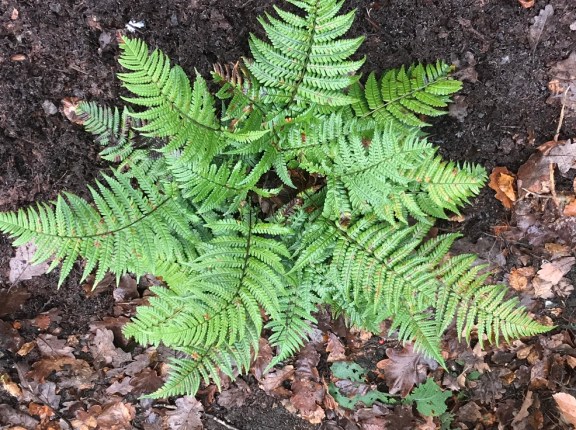
Fig. 5 Polystichum polybretharum
Fig. 5 is Polystichum polyblepharum, one of my favourite evergreen ferns.
Fig. 6 Photinia serratifolia ‘Pink Crispy’
Fig. 6 is Photinia serratifolia ‘Pink Crispy’
Fig. 7 Equisetum hyemale
Fig 7 is Equisetum hyemale. I am including this plant because I like it as an architectural feature but not its habit of sprouting lots of small offshoots from the tips and sides of the stems. Last year I had a large pot bound specimen which I thought of discarding but instead I divided it and potted up a couple of divisions.Some time later I cut the potted plants down to the ground and the picture shows the resulting new growth. I am pleased with this result and now wished I had saved a third specimen.
Fig. 8 Ilex aquifolium ‘Golden Queen’
Fig. 8. This is the stem of a large standard Ilex aquifolium ‘Golden Queen’ which I planted as a shrub over 25 years ago. I trained it as a standard to add height and to indicate the extremity of the garden. I really like the new cream shoots that have appeared near the base of the trunk, presumably due to lack of light – a bonus.
Fig. 9 Underplanted conifer
Fig 9 I underplanted the conifer Chamaecyparis pisifera ‘Plumosa Aurea Nana’ with Carex morrowii ‘Ice Dance’ since it is tough and tolerates shade. It has survived amongst the roots of the conifer where other plants have failed. It is accompanied by Chiastophyllum oppositifolium ‘Jim’s Pride’.
Aeoniums are natives of Madeira, the Canary Islands and North Africa, climates that do not experience sub-zero temperatures, consequently plants need protection in the UK during winter.
Fig 1: Greenhouse ready for winter
I insulated my greenhouse in November to accommodate them. I had to remove everything in the greenhouse to install the bubble wrap.
In Fig 1, I have just started to return the plants.
In the video below all the plants have been returned to the greenhouse and as you can see I have quite a few Aeoniums.
Many of them are the black Aeonium ‘Zwartkop’ but I also have several of the bright green species A. arboreum. The display in Fig 2 highlights the contrast in colour of the two Aeoniums.
Fig 2
Another species I have is called A. ‘Blushing Beauty’ given to me by our late much esteemed member Roberto Renzi. This plant normally has pink tinges to the leaf tips, but it needs sun to develop the colour so the leaves are plain green in winter. My fourth and final species is A. ‘Sunburst’ purchased at Harrogate show last Spring (fig 3).
Fig 3: A. ‘SunburstFig 4: New succulent arrangement for 2021
I have recently put together an arrangement of this Aeonium with Echeveria Peacockii (fig 4) . This is a succulent from the same family Crassulaceae and has similar cultural requirements.The display should look better when some growth occurs. The Echeveria was purchased from Merriments in East Sussex a couple of years ago. They had a superb display of several of them planted outdoors. I have already propagated my plant from offsets which were used for the Fig 4 display. The original plant and remaining offshoots can be seen in Fig 5.
Fig 5: New Echeveria and babies
One of the problems with Aeoniums is their quick vertical growth but they may still look stunning, as seen in the examples in figures 6 and 7.
Fig 6: Aeoniums in large blue potFig 7: Aeoniums in small pot
When Aeoniums get leggy the tops may be cut off with say 50 to 100 mm of stem and rooted easily in a cutting mixture. The cutting must be allowed to dry for a few days until the wound has calloused before potting up. I like to use an upturned plant pot to ensure the stem remains upright – see this video .
Aeoniums are monocarpic, meaning they die after blooming. When Aeoniums form branches, not all the stems necessarily flower at once; the flowering stem(s) may be removed giving a good chance for the plant to survive. Out of interest Fig 8 shows an Aeonium in flower and fig 9 shows a flower on one stem which may be removed if desired.
Fig 8: Aeonium in flowerFig 9: Aeonium in flower on one stem
It is also interesting to try to get Aeoniums to branch out. You can simply chop off the top (the removed stem can then be use as a cutting) and then ideally cut the stem down again leaving perhaps 50 to 100 mm of remaining stem which is then allowed to regrow (Fig 10). Another technique is to carve out the growing point but this it is not easy as the leaves are tightly packed. If successful, the plant produces new shoots as illustrated in Fig 11.
I have several tender succulents, so my greenhouse is maintained at minimum 5°C (see Appendix 1). To justify the equipment and cost, I try and use the facility as much as possible to overwinter tender perennials, cuttings, Pelargoniums, and some half hardy Fuchsias. Some of the latter are now up to 4 years old, so are of decent size and give a wonderful display in summer. I use Fuchsias quite a lot for summer displays because I have lots of shade. Fig 12 shows Fuchsia ‘Voodoo’ in a shady north facing position in early August. I trim and defoliate all my fuchsias for winter storage.
Now my greenhouse is fully utilised for a variety of functions, perhaps I am not so fixated about Aeoniums after all.
Appendix
To maintain the greenhouse temperature at not less than 5°C, I use an electric fan heater. Although it has an anti-frost setting it does not control the temperature well enough. The Novatec thermostat works incredibly well. The fan is set on the heat setting and is connected to the thermostat unit. It will only come on when the thermostat detects the temperature falling below 6°C. It will control temperature to an accuracy of +/- 1°C so will switch off the heater when appropriate.
In late spring the thermostat can be switched to cooling mode when required. The fan heater element is now switched off, but the fan remains operational. The thermostat is now set to an upper temperature limit which when exceeded automatically starts the fan to cool the greenhouse.
I can also monitor the greenhouse temperature in the house using a weather station (fig 13). I have two remote sensors one in the garden and one inside the greenhouse. I check every morning to see what maximum and minimum temperatures have been recorded.
Fig 13: Weather Station
Perhaps the most important implement however is the greenhouse door which is opened and closed as appropriate to hopefully minimise mildew etc as well as helping to control temperature.
Had Covid19 not forced the cancellation of the AGS event, originally scheduled to take place at Harlow Carr on October 14th, I am sure that during the past couple of weeks I would have been planting some of these little jewels which I would have been unable to resist buying. I say ‘little jewels’, and they are usually sold by nurseries specialising in alpine and woodland plants, but although some are grown as ‘specimen’ plants, largely for foliage effect, many are robust, very good garden plants which are extremely useful at this time of year.
Saxifraga fortunei was first introduced to Great Britain from China by the English Botanist William Jackson Hooker, and named for the Scottish Plant Hunter Robert Fortune, in the mid 19th century, and is native to China, Japan & Korea. Whilst the species form has white flowers, there are now many named forms in colours from white, through various shades of pink, to darkest red. I would describe them as ‘quiet plants’, almost the Autumn equivalent of hepaticas; you hardy notice the foliage emerging but when it becomes crowned with the delicate flowers, they are such a welcome sight at this time of year.
They are herbaceous perennials and, according to the official advice, prefer a shady, or part shady spot with the usual ‘moist but well drained’ soil. However, I find that by October, when the sun has lost much of its strength, few gardens can really be said to be in ‘full sun’ so S. fortunei can withstand a more open position, and this, now sadly unlabelled, plant (right)
performs beautifully in my garden in a relatively open spot. From my experience, and this may just be me, I find that the white and pale pink varieties are more floriferous.
S. fortunei ‘Reica’
The deep pink and red varieties are more dramatic with the flowers set against often dark foliage, but I find the flowers can be rather more sparse, as shown on this plant of S. fortunei ‘Reica’.
When I started thinking about writing this, I got out my copy of ‘Plant Finder’ to check on some of the named varieties. I expected to find them all recorded, in alphabetical order under the heading ‘fortunei’, but instead I discovered them all, in common with all other named varieties of other Saxifraga species, in alphabetical order, spread throughout the full list of Saxifraga entries, followed by (fortunei) and (5) so, for example the entry for one of the best known varieties ‘Wada’ reads ‘Wada’ (fortunei) (5). Turning to the front of ‘Plant Finder’ I discovered that there are 15 classifications of Saxifraga; class 5 is entitled ‘Irregulares’ and describes plants in this class as ‘shade-tolerant, usually herbaceous perennials forming rosettes of broad, palmately lobed leaves, with leafless stems bearing lax panicles of small flowers with short upper, and longer lower petals, in summer or autumn’.
Shortly after discovering all this, I was in the company of a very knowledgeable friend and said to him, ‘explain to me, in words of one syllable that even I will understand, about Saxifraga classifications’. He gazed into space, as if thinking ‘where do I begin?’, but then said, ‘I shouldn’t worry about it’, so I won’t, but just enjoy these lovely plants for what they are. I am indebted to our Secretary Pat who has sent me some images taken at Holehird recently, and to a friend with whom I was visiting Harlow Carr and who photographed various examples on display in the Alpine House. Their images appear below.
S. fortunei ‘Wada’
S. fortunei ‘Sybill Trelawney’
S. fortunei ‘Sugar Plum Fairy’
S. fortunei ‘Shiranami’
You may not be surprised to hear that, having spent some time thinking about these lovely plants, I think I can accommodate several more in the garden, and an order has been sent off to one of my favourite nurseries!
On a gloriously sunny, balmy, afternoon today, I was privileged to visit the Yorkshire Arboretum at Castle Howard. There are big changes afoot with a new building under construction which will accommodate the UK’s first purpose built ‘Tree Health Centre’ and, like many other places, due to Covid19, the Arboretum was closed for a period earlier in the year but it is now making up for lost time with pre-booked visitors enjoying the glorious Autumn colours.
If you have never visited the Arboretum, now and in the coming weeks is a wonderful time to do so; the café is open from 11am serving delicious drinks and light meals.
Below are a few images of the sights that await you.
And here are some of the individual plants that caught my eye
We missed our Plant Forum in August, like so many other events in this year of Covid-19, so it is proposed that we have some virtual ones! For October, please send your nominations, suitably illustrated, for the best Autumn colour, be it tree, shrub or perennialto brian.hackett7@icloud.com
Sue Gray has started the ball rolling with her nomination for Euonymus alatus – the Burning Bush
Euonymus alatus
Acers are always reliable purveyors of autumn colour, but this one in the Hackett garden, is better known for its winter bark– Acer palmatum ‘Sango-kaku’
Acer palmatum ‘Sango-kaku’ – the Coral-bark maple
Pat Gore says: “What a difficult choice! I have some lovely Acers, a Rhys typhina dissecta, a butter yellow Morus nigra – all of which give a great autumnal display.
However, I would like to nominate Viburnum plicatum ‘Mariesii’ as providing my favourite Autumn colour. It starts to turn in late Summer and goes an increasingly dark wine red over the succeeding months. It also has a second small flush of flowers which look lovely against the dark foliage. The leaves are held until late Autumn and I would not expect them to fall until mid- late November.
I have a bird’s eye view of it when I open my bedroom curtains every morning so it gives me a lot of pleasure throughout much of the year.”
Viburnum plicatum f. tomentosum ‘Mariesii’
Terry Benton of Westbury, Wiltshire was a regular contributor to our lockdown gallery. Here’s his nomination: “The choice from my garden is Hesperantha coccinea ‘Major’. It’s not an unusual plant but the flowers provide a strong colour among the garden’s fading hues. I find them still standing proud and blooming long after the leaves have fallen from the trees.”
Hesperantha coccinea’Major’
Ann Fritchley offers the Crimson Bromeliad – Fascicularia bicolor. “Unfortunately”, she says, “the pale blue flowers in the centre have gone over”. Still pretty exotic for October!
Fascicularia bicolor
Judith Ladley gives us an old and trusted favourite. “I would have sent a picture of Parthenocissus tricuspidata which has been superb but is now nearly finished. Therefore I nominate Verbena bonariensis which self-seeds freely in my gravelled area. In the background is Catalpa bignonioides ‘Aurea’ which has done very well this year. I cut it back in Spring.
Verbena bonariensis
Judith Edmonds picks an Acer: “Here’s my vote for autumn colour: Acer Palmatum ‘Chitose-yama’. Seen at the Himalayan Garden & Sculpture Park, Grewelthorpe, last week. As well as the dramatic colour, I thought the leaves were also a very beautiful shape. It’s definitely on my wish list now! Having checked it out on the RHS website I see it has an AGM and the leaf colour earlier in the year looks good too.”
Acer palmatum ‘Chitose-yama’
Kate van Heel’s nomination is Polypodium cambricum ‘Richard Kayse’. She says “It’s a winter growing fern that is a fabulous lime green at the moment”
Polypodium cambricum ‘Richard Kayse’
Katherine Hill offers two contrasting takes on autumn colour
Acer Palmatum at Kalzie Gdns, Peebles
Tree wearing a fur coat of lichen, Dawyck Botanical Gdns. nr Peebles